
Eva Moreda Rodr铆guez records two zarzuela romanzas
Eva Moreda Rodr铆guez (soprano) and Adam Cigman-Mark recorded the zarzuela romanzas 鈥淎y de m铆鈥� (from Ruperto Chap铆鈥檚 El rey que rabi贸) and 鈥淐anci贸n del espejo鈥� (from Manuel Fern谩ndez Caballero鈥檚 La viejecita) at the fifth symposium of the series, held at City University London on 19th January 2023, under recording engineer Duncan Miller.

Eva Moreda Rodr铆guez (soprano) and Adam Cigman-Mark recorded the zarzuela romanzas 鈥淎y de m铆鈥� (from Ruperto Chap铆鈥檚 El rey que rabi贸), under recording engineer Duncan Miller.
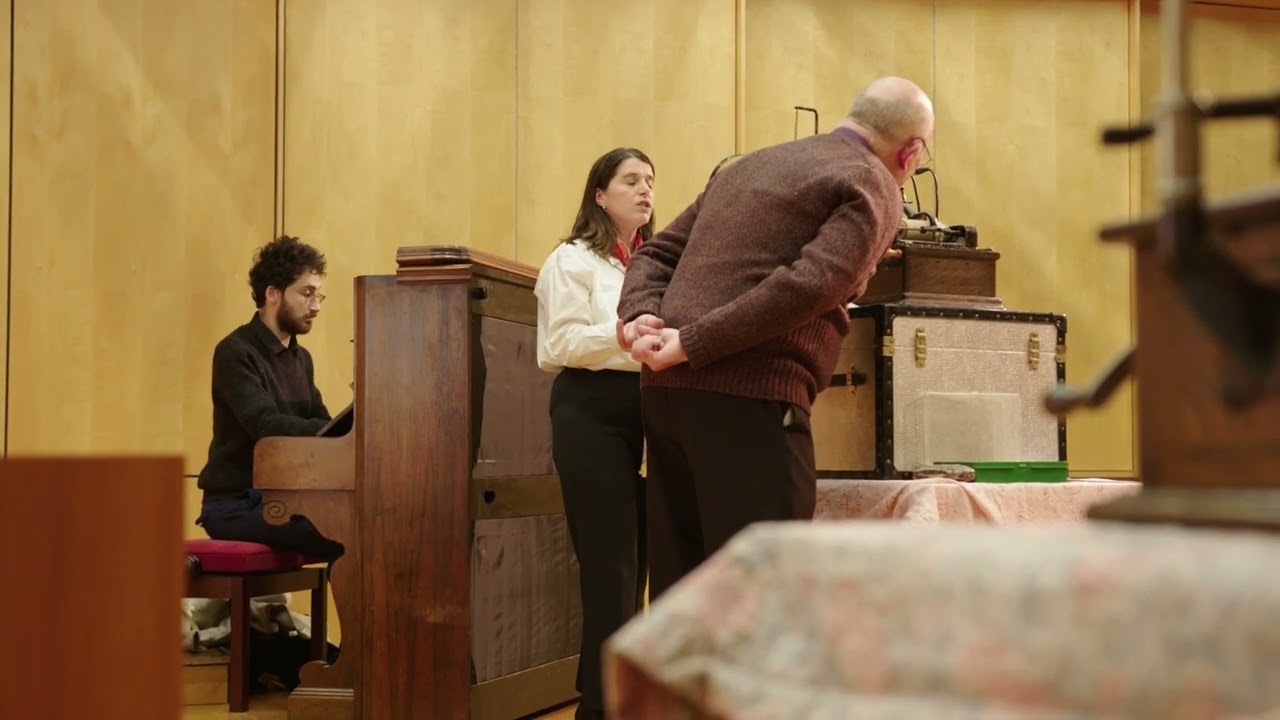
Eva Moreda Rodr铆guez (soprano) and Adam Cigman-Mark recorded the zarzuela romanzas 鈥淐anci贸n del espejo鈥� (from Manuel Fern谩ndez Caballero鈥檚 La viejecita), under recording engineer Duncan Miller.
Eva's commentry on the experience
Before I recorded for the phonograph, I was in the rather unique position of having seen about fifteen other musicians do the same as well as having spent several years researching and thinking about early zarzuela recordings 鈥� so perhaps the biggest shock for me was that I was not more shocked! Whereas other performers in our phonograph-recording sessions reported how strange they found the experience, in my case I think it complemented, confirmed or expanded into new directions what I already suspected, rather than challenging it decisively.
In early zarzuela recordings, there is a concern with communicating text expressively; this does not necessarily mean clear diction at all points, but rather that a range of expressive devices (portamento, legato, tempo modifications, presence or absence of vibrato) are enlisted to render the 鈥渟hape鈥� of the text accessible and relatable. In the run-up to the session, I experimented with these parameters to see how they could help me engage an audience with the text, but this doesn鈥檛 mean my performance was rigidly planned: instead, I made sure that there was a palette of resources available to me 鈥渋n the moment鈥�.
If we had had more time, I would have definitely have made several takes and experienced with these parameters to a greater extent, particularly tempo changes 鈥� I found myself rushing along quite a bit, for fear that the cylinder would run out (length was 2 minutes). It is quite interesting that, for both romanzas that I recorded, some of the original early recordings are quite brisk and rigid in tempo, and others are slower and featured more tempo freedom; this could either mean that a range of styles coexisted in performing zarzuela, or that earlier performers felt similarly pressured to rush along to fit the whole piece in.
Something I did find surprising was how the diction comes through relatively well (and I thought the same of F谩tima鈥檚 cylinders). Even though I had in mind at all times communicating text expressively through musical means, the truth is that I wasn鈥檛 really going out of my way to enunciate clearly. This has opened up questions regarding the zarzuela cylinders that I study. For those in which diction is blurrier, I had assumed that there could be two possibilities: it could be that performers strived for good diction as a norm when they were on the stage, but they were aware of the obliterating effect of the phonograph and therefore tried to overcompensate through musical means; or (more likely) that at least some performers didn鈥檛 have clear diction as a priority, instead using a mixture of musical means to communicate text expressively, with the phonograph therefore capturing the 鈥渄efault鈥� for these performers. But my experience has opened up some questions 鈥� I now wonder if the blurriness in the diction has to do with the deterioration of the material rather than with anything inherent to the phonograph. Of course it could also be that being able to capture diction with such clarity requires skills that earlier Spanish recordists did not master.